
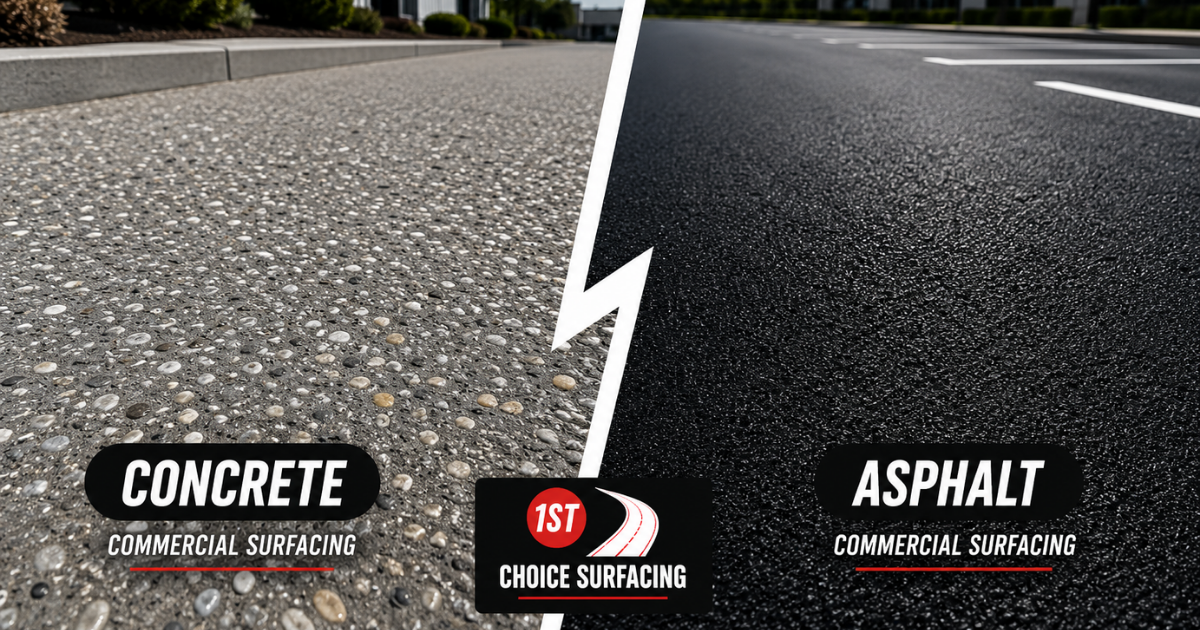
If you’re weighing concrete vs asphalt for commercial surfacing, the honest answer is that neither material wins outright. Asphalt is generally quicker and cheaper to install and simpler to repair. Concrete costs more upfront but tends to shrug off sustained heavy loading and needs less routine attention over its life. Which one suits your site depends on traffic volume, vehicle weight, ground conditions, drainage and budget. This guide works through each factor so you can make a properly informed decision.
Quick Answer / Key Takeaways
Asphalt Surfacing: Lower initial cost, faster installation, straightforward repairs — strong for car parks and moderate-traffic sites.
Concrete Surfacing: Higher upfront cost, greater rigidity, better resistance to rutting under sustained heavy loading — often favoured for HGV yards and loading bays.
Neither is automatically the right choice. It depends on traffic profile, sub-base, drainage and how long you need the surface to last.
Concrete vs Asphalt for Commercial Surfacing: What's the Difference?
Asphalt (often called tarmac in everyday UK usage, though the two aren’t technically identical) is a flexible pavement built from bitumen-bound aggregate laid in compacted layers over a prepared sub-base. Because it flexes slightly under load and temperature change, it distributes traffic stress through the whole pavement structure rather than resisting it rigidly.
Commercial concrete surfacing is a rigid pavement — a reinforced or unreinforced slab that spans the sub-base and carries load through its own structural strength. That rigidity is why concrete tends to perfup orm well under concentrated, repeated loading from HGVs, forklifts and static plant, but cracks and joint movement are handled differently, and repairs are more involved.
The choice isn’t purely material versus material. Pavement design, layer thickness, reinforcement, sub-base specification and drainage, often matters as much as which surface you lay on top.
Concrete vs Asphalt Cost for Commercial Projects
Asphalt paving generally carries a lower initial cost than concrete installation of equivalent thickness, largely because it can be laid, compacted and opened to traffic faster. Concrete requires more time for formwork, reinforcement (where specified) and curing, which extends the programme and site costs.
Beyond the headline material cost, several factors shape the real project figure:
- Site access for plant and materials
- Excavation depth and ground condition
- Sub-base specification, which may need strengthening for HGV traffic regardless of surface choice
- Drainage provision, including falls, gullies and permeable detailing
- Project size — larger continuous areas achieve better rates per square metre
- Traffic management needed during works
We won’t quote a blanket UK price here, as costs genuinely vary by site condition and location — a proper figure follows a site assessment. Worth noting: asphalt’s lower installation price can be offset over 15–20 years by more frequent resurfacing, while concrete’s higher upfront spend is often balanced by lower routine maintenance.
Which Lasts Longer: Concrete or Asphalt?
Concrete generally has the potential for a longer service life than asphalt when designed and installed correctly, largely because its rigidity resists rutting and deformation under sustained loading. Asphalt, properly specified and maintained, still delivers a solid working life and can be resurfaced relatively easily when it starts to show wear.
Lifespan isn’t a fixed number for either material — it’s determined by construction quality, sub-base strength, drainage (standing water shortens the life of both surfaces fast), traffic volume, vehicle weight, maintenance strategy and UK climate exposure, including freeze-thaw cycling.
A well-built asphalt car park with good drainage can outlast a poorly specified concrete yard. Installation quality matters more than the material label alone.
Heavy-Traffic Performance: Concrete vs Asphalt
This is where the two materials diverge most clearly. Concrete’s rigid structure handles concentrated, repeated loading — HGVs, delivery vehicles, forklifts and static trailers — with less risk of rutting than asphalt, particularly on braking zones, tight turning circles and loading bay aprons where vehicles pivot and apply shear force to the surface. Where the same small area takes repeated heavy axle loads day after day, concrete’s resistance to permanent deformation is a genuine advantage.
Properly designed asphalt can still perform well under heavy traffic given adequate depth, a suitably engineered binder course and a sub-base built for the loading it will carry. Underspecified asphalt is the usual cause of rutting at warehouse entrances — not the material itself.
Many industrial sites use both: concrete at the highest-stress points, such as loading bays and yard aprons, with asphalt across the wider yard and access routes where loading is more evenly distributed.
Maintenance and Repair Requirements
Asphalt is easier and faster to maintain. Cracks and potholes can be cut out and patched without shutting down a whole site, and resurfacing is a comparatively quick, low-disruption job. Regular sealing and crack maintenance extends life significantly and is easy to schedule around business operations.
Concrete needs less routine attention day to day, but when problems do appear — joint failure, slab cracking or localised deterioration — repairs are typically more involved. Full or partial slab replacement may be needed rather than a simple patch, and matching new concrete to existing slabs takes more care. Joint sealant maintenance is also worth budgeting for over the surface’s life.
Installation Time and Business Disruption
Asphalt’s big practical advantage is speed. It’s laid, compacted and can typically be opened to light traffic within hours once cooled, with full curing continuing over subsequent days — useful for a live retail site or depot that can’t tolerate extended closure.
Concrete needs formwork, placement, finishing and a proper curing period — often several days before it can safely take vehicle traffic, and longer for full strength. Phased working or scheduling around quieter periods makes this manageable, but a site needing to reopen quickly should plan around it with the contractor from the outset.
Which Is Better for Commercial Car Parks, Industrial Yards and Access Roads?
Commercial car parks — asphalt is widely used thanks to lower cost, faster installation and straightforward line-marking, and it copes well with distributed, lighter car park traffic.
Industrial yards — concrete often earns its keep where HGVs, forklifts and static trailers apply concentrated, repeated loads on hardstanding and loading areas.
HGV and loading areas — concrete’s rigidity resists the rutting and shoving that braking and turning heavy vehicles cause, making it a common choice for loading bay aprons.
Commercial access roads — well-specified asphalt suits most routes, with concrete reserved for junctions carrying the heaviest, most concentrated loading.
Retail and business premises — asphalt’s speed of installation and lower disruption often make it the practical choice where the site needs to stay operational.
Concrete vs Asphalt Comparison Table
Factor | Asphalt | Concrete |
Initial cost | Generally lower | Generally higher |
Installation speed | Faster, open to traffic sooner | Slower, requires curing time |
Lifespan | Solid with good maintenance | Potentially longer if well specified |
Heavy-load performance | Good when properly specified | Strong resistance to rutting |
Maintenance | More frequent, routine | Less frequent |
Repairs | Quick, low-disruption patching | More involved, slab-level work |
HGV traffic | Suitable with adequate design | Well suited, especially loading zones |
Commercial car parks | Very common, cost-effective | Used selectively |
Industrial yards | Suitable for wider areas | Preferred for high-stress zones |
Long-term value | Strong if maintained on schedule | Strong where loading is heavy |
Which Commercial Surfacing Option Should You Choose?
Choose asphalt when your site carries moderate, distributed traffic, you need the area back in use quickly, budget is a primary constraint, or you want a surface that’s simple to maintain.
Choose concrete when your site takes sustained heavy or concentrated loading — HGVs, forklifts, trailers standing under load — particularly at turning points, braking zones and loading bays, and you’re prepared to invest more upfront for lower routine maintenance later.
In most cases, the right answer comes from a proper site assessment rather than a general rule. Traffic volume, vehicle weight, turning movements, ground conditions, drainage, sub-base strength, budget and project timescale all feed into the recommendation — and pavement design can matter as much as the surface material itself.
Conclusion
Neither asphalt nor concrete is universally better for heavy commercial traffic — each performs strongly in the conditions it’s designed for. Concrete generally has the edge for sustained, concentrated heavy loading such as HGV yards and loading bays. Asphalt generally wins on cost, installation speed and ease of repair, and performs well under heavy traffic when specified correctly.
1st Choice Surfacing works with commercial clients across car parks, industrial yards, access roads and loading areas, assessing traffic loading, drainage and sub-base conditions to recommend the option that suits the site.
Frequently Asked Questions
Is asphalt or concrete better for heavy traffic?
Concrete handles concentrated loads and heavy turning best. Asphalt works well for distributed traffic if designed with adequate sub-base depth.
Is concrete more expensive than asphalt?
Concrete costs more upfront due to installation complexity, but lower routine maintenance narrows the whole-life cost gap.
Is asphalt suitable for HGV traffic?
Yes, as long as it is specified correctly for expected axle weights to prevent rutting.
What is the best surface for a commercial car park?
Asphalt, because it is cost-effective, fast to install, and ideal for distributed car traffic.
Is concrete better for industrial yards?
Yes, for high-stress zones like loading bays and turning areas, though many yards combine both materials.