
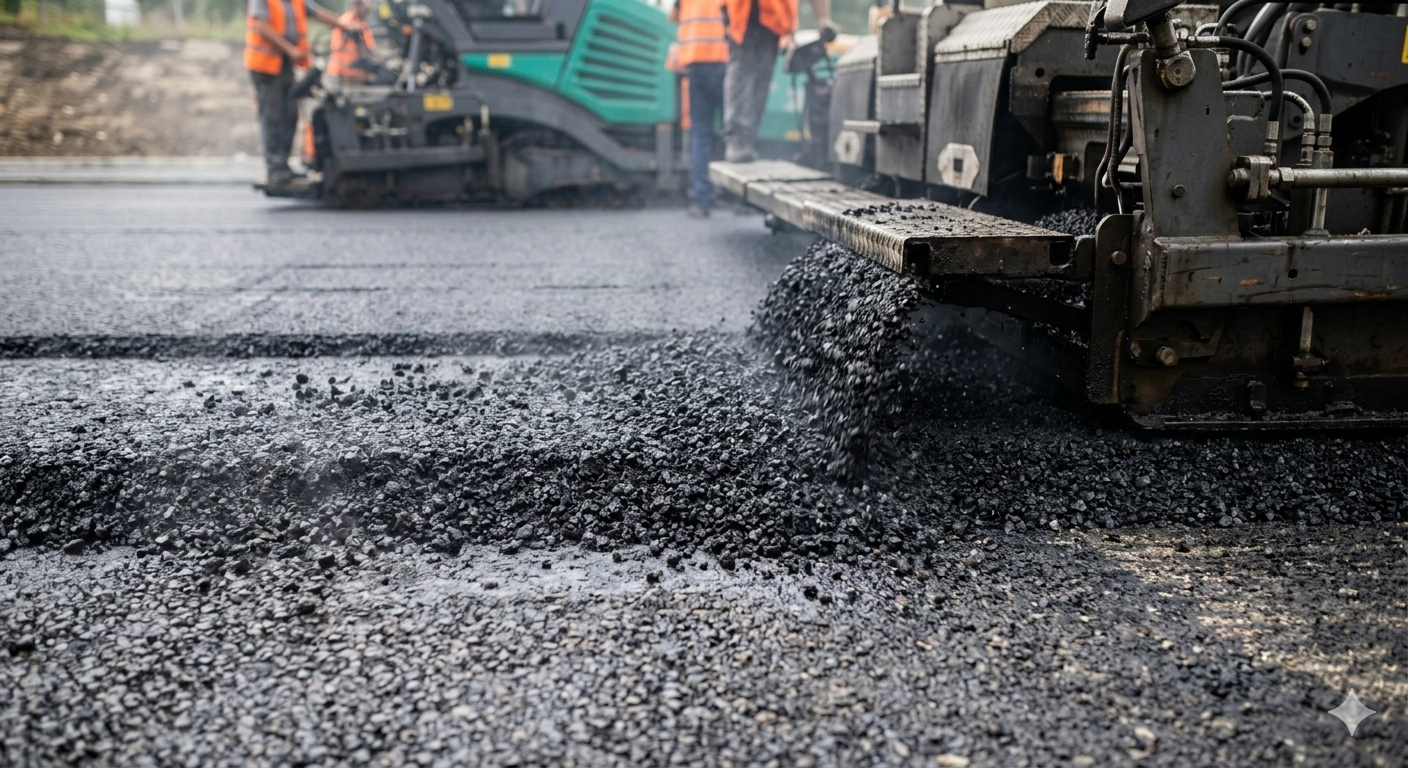
If you’re managing a business premises, car park, industrial estate, or retail complex, the quality of your surfacing matters more than most people realise. Commercial asphalt is one of the most practical, cost-effective, and durable paving solutions available,and at 1st Choice Surfacing, we work with businesses across the UK every day to help them get the right surface for their needs. This guide breaks down everything you need to know: from the different types of asphalt available to what drives the cost, and exactly what happens during an installation.
What Is Commercial Asphalt?
The commercial asphalt used for paving is a mixture of aggregates like stone, gravel, or sand along with a black sticky substance called bitumen, which is obtained from crude oil. When properly installed, a commercial asphalt paving provides a smooth surface that can withstand heavy loads from vehicles for a long period of time.
While residential driveways can be a smaller affair, commercial asphalt paving is a bigger deal, covering car parks for businesses, loading areas, access roads, and yard surfaces for industries. All these require a higher specification of asphalt as well as a more advanced laying process to support forklifts, HGVs, or heavy pedestrian activity.
At 1st Choice Surfacing, we treat each commercial site on a case-by-case basis because we believe no two sites are alike. Factors such as ground conditions, drainage needs, load capacity, and even regional weather all come into play when specifying a commercial asphalt solution.
Types of Commercial Asphalt: What Are Your Options?
Choosing the right asphalt type is critical. Use the wrong mix for your application, and you could face premature cracking, rutting, or water ingress within just a few years. Here’s a breakdown of the most commonly used commercial asphalt types in the UK:
1. Dense Bitumen Macadam (DBM)
Dense Bitumen Macadam (DBM) is the workhorse of the industry. It is a robust and high-density material. It is generally used for base and binder courses in commercial and industrial schemes. It has good load-bearing properties and is therefore suitable for lorry parks, warehouse yards, and access roads. It is not generally used as the wearing course. It provides the structural base for the wearing course.
2. Hot Mix Asphalt (HMA)
Hot mix asphalt is constructed at high temperatures, generally between 150°C and 190°C. The high temperature enables thorough compaction, providing a dense and watertight surface. It is highly resistant to deformation and is therefore the best option for commercial schemes where traffic is high and durability and lifespan are the priority.
3. Stone Mastic Asphalt (SMA)
Stone Mastic Asphalt is the premium product for the wearing course in heavy-duty traffic situations. It has a stone skeleton structure, providing excellent resistance to rutting. It is therefore suitable for bus lanes, lorry parks, and commercial driveways where traffic stops and starts. It has a coarse aggregate content, giving good skid resistance.
4. Porous / Permeable Asphalt
Porous asphalt has become more popular in recent years as the need for sustainable drainage systems (SuDS) has become more important in obtaining planning consent in the UK. It allows rainwater to drain through the surface. It is therefore a good option for commercial properties in flood-prone areas and for obtaining planning consent.
5. Cold Mix Asphalt
Cold mix is a cost-effective alternative used for patching, minor repairs, or small jobs that don’t justify the expense of hot plant equipment. It dries at room temperature and will not provide the same results as hot mix but is a viable alternative nonetheless.
At 1st Choice Surfacing, we can assist you in selecting the appropriate specification based on the site conditions, traffic requirements, and cost constraints. Incorrect selection can result in doubled maintenance costs.
Commercial Asphalt Costs: What Should You Budget?
One of the first questions businesses ask us is: ‘How much does commercial asphalt cost?’ The honest answer is that it depends on several variables, but we can give you a realistic framework.
Key Cost Factors
- Site size and layout — larger areas benefit from economies of scale
- Depth of installation — commercial specifications often require 100–150mm total depth
- Sub-base condition — poor ground conditions increase prep and material costs
- Asphalt type selected — SMA and HMA command a premium over DBM
- Drainage requirements — kerbing, gullies, and SuDS systems add cost
- Access and plant logistics — tight urban sites or remote locations affect pricing
- Line marking and finishing — car park bays, hatching, and signage
Approximate UK Cost Ranges
As a general guide for commercial asphalt installation in the UK:
- Basic car park resurfacing: £15–£25 per m²
- New commercial car park (full construction): £30–£60 per m²
- Industrial yard or HGV area: £40–£70 per m²
- Porous asphalt surface: £25–£45 per m²
These are indicative figures only. For an accurate quote tailored to your site, 1st Choice Surfacing offers free, no-obligation surveys across the UK. We believe in transparent pricing, no hidden costs, no surprises.
The Commercial Asphalt Installation Process: What to Expect
Understanding the installation process helps you plan effectively, minimise disruption, and hold your contractor to account. Here’s what a professional commercial asphalt installation typically involves:
Step 1: Site Survey & Design
Before the machines even begin work, the site is surveyed. This involves examining the existing state of the ground, the load-carrying capacity of the ground, the ground’s water tables, and the existing positions of the utilities.
Step 2: Sub-Base Preparation
The most critical part of the paving process is the sub-base construction. This is because a poorly constructed sub-base is a recipe for disaster. This is the point at which the ground is excavated to the formation level, the soft spots removed, the ground compacted, and the granular sub-base laid. This is usually Type 1 MOT stone.
Step 3: Binder Course Installation
The binder course is sometimes referred to as the base course or the regulating course. This is the course that provides the pavement’s structural depth. Dense Bitumen Macadam is the most commonly used course at this level. It is machine-laid and compacted to a precise depth.
Step 4: Wearing Course Installation
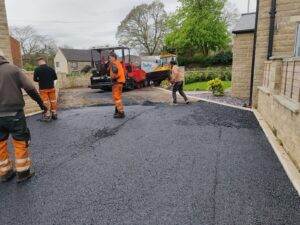
The wearing course is the course that is visible and is driven on. This course can be hot mix asphalt, Stone Mastic Asphalt, or a porous course. It is machine-laid to a precise depth and then rolled with heavy rollers. This is the point at which the edging, the kerbing, and the gullies are completed.
Step 5: Line Marking & Finishing
Once the surface has cooled and hardened (usually within 24–48 hours), thermoplastic or paint line marking can be applied. For commercial car parks, this includes bay markings, disabled spaces, directional arrows, hatching, and any required signage.
Step 6: Final Inspection
A quality contractor like 1st Choice Surfacing will carry out a final inspection to check levels, falls, compaction quality, and visual finish before signing off. We stand behind our work and provide workmanship guarantees as standard.
How Long Does Commercial Asphalt Last?
A properly installed commercial asphalt surface, with appropriate maintenance, can last 20–30 years. The keyword is ‘properly.’ Poor sub-base preparation, incorrect material specification, or inadequate drainage will shorten that lifespan dramatically.
Regular maintenance extends life significantly. Crack sealing, pothole repair, and periodic re-treatment of the surface every 7–10 years can double the effective lifespan of your investment. 1st Choice Surfacing also offers maintenance contracts for businesses that want proactive care of their commercial surfaces.
Commercial Asphalt vs. Concrete: Which Is Right for You?
A common decision businesses face is asphalt versus concrete. Both have merits, but for most commercial applications in the UK, asphalt wins on practical and economic grounds:
- Cost: Asphalt is typically 30–40% cheaper to install than concrete
- Speed: Asphalt surfaces can be open to traffic within hours of installation
- Repairability: Asphalt is far easier and cheaper to repair than concrete
- Flexibility: Asphalt handles ground movement better, reducing cracking
- Sustainability: Asphalt is 100% recyclable — old material is reclaimed and reused
Concrete may be preferred for certain specialist applications such as heavy chemical exposure areas or extreme point load environments — but for the vast majority of commercial paving projects, asphalt delivers the best overall value.
Why Choose 1st Choice Surfacing for Your Commercial Asphalt Project?
1st Choice Surfacing has built a reputation across the UK for delivering high-quality commercial surfacing solutions with minimal disruption to your business operations. We understand that your car park, access road, or yard isn’t just infrastructure — it’s part of how your business operates day-to-day.
- Free, no-obligation site surveys with detailed written quotations
- Experienced, fully insured surfacing teams with commercial specialism
- Approved contractors working to BS EN standards
- Full project management from survey to sign-off
- Competitive pricing with transparent, itemised quotes
- Workmanship guarantees on all commercial projects
Whether you need a small car park resurface or a full new-build yard construction, we have the expertise, plant, and personnel to deliver it on time and on budget. Visit us at 1stchoicesurfacing.co.uk to request your free survey today.
Ready to discuss your commercial asphalt project? 1st Choice Surfacing is here to help. Contact our team today for your free, no-obligation site survey and discover why businesses across the UK trust us with their surfacing needs. Visit us at 1stchoicesurfacing.co.uk
Frequently Asked Questions About Commercial Asphalt
Q1: What is the difference between commercial and residential asphalt?
Commercial asphalt is specified and installed to higher load-bearing and durability standards than residential surfacing. It uses thicker layer depths, denser aggregate mixes, and is designed to withstand heavy vehicles, constant traffic, and prolonged use. Residential driveways typically use lighter surface course mixes over a thinner sub-base.
Q2: How long does commercial asphalt installation take?
Most commercial asphalt projects take between 1 and 5 days depending on size and complexity. A standard car park resurfacing can often be completed in 1–2 days. Larger new-build projects with sub-base preparation may take up to a week or more. 1st Choice Surfacing works around your business hours where possible to minimise disruption.
Q3: Can commercial asphalt be laid in winter?
Hot mix asphalt can be laid in temperatures down to approximately 5°C, though frost and wet conditions can affect workmanship quality. Cold mix asphalt has more flexibility for winter repairs. For major commercial projects, spring through autumn is the ideal installation window in the UK.
Q4: How much does it cost to resurface a commercial car park?
Commercial car park resurfacing in the UK typically costs between £15 and £35 per m², depending on the existing surface condition, drainage requirements, and the specification of asphalt used. A full new-build car park construction will cost more. 1st Choice Surfacing provides free site surveys with detailed, transparent quotations.
Q5: How do I know if my commercial asphalt needs replacing or just repairing?
If your surface shows isolated potholes, minor cracking, or surface weathering, repairs and resurfacing may be sufficient. If you’re seeing extensive cracking (alligator or block cracking), significant rutting, or widespread failure of the sub-base, full reconstruction is likely needed. A professional survey from 1st Choice Surfacing will give you an honest assessment.
Q6: Is commercial asphalt environmentally friendly?
Yes, asphalt is one of the most recycled materials on earth. In the UK, approximately 95% of reclaimed asphalt is reused in new surfaces, significantly reducing its carbon footprint. Porous asphalt variants also support sustainable drainage, reducing surface runoff and local flood risk.
Q7: What maintenance does commercial asphalt require?
Routine maintenance includes regular inspection, prompt repair of any cracks or potholes before they spread, keeping drains clear, and considering re-treating the surface every 7–10 years. A proactive maintenance programme significantly extends the life of your asphalt surface and defers expensive full replacement.